
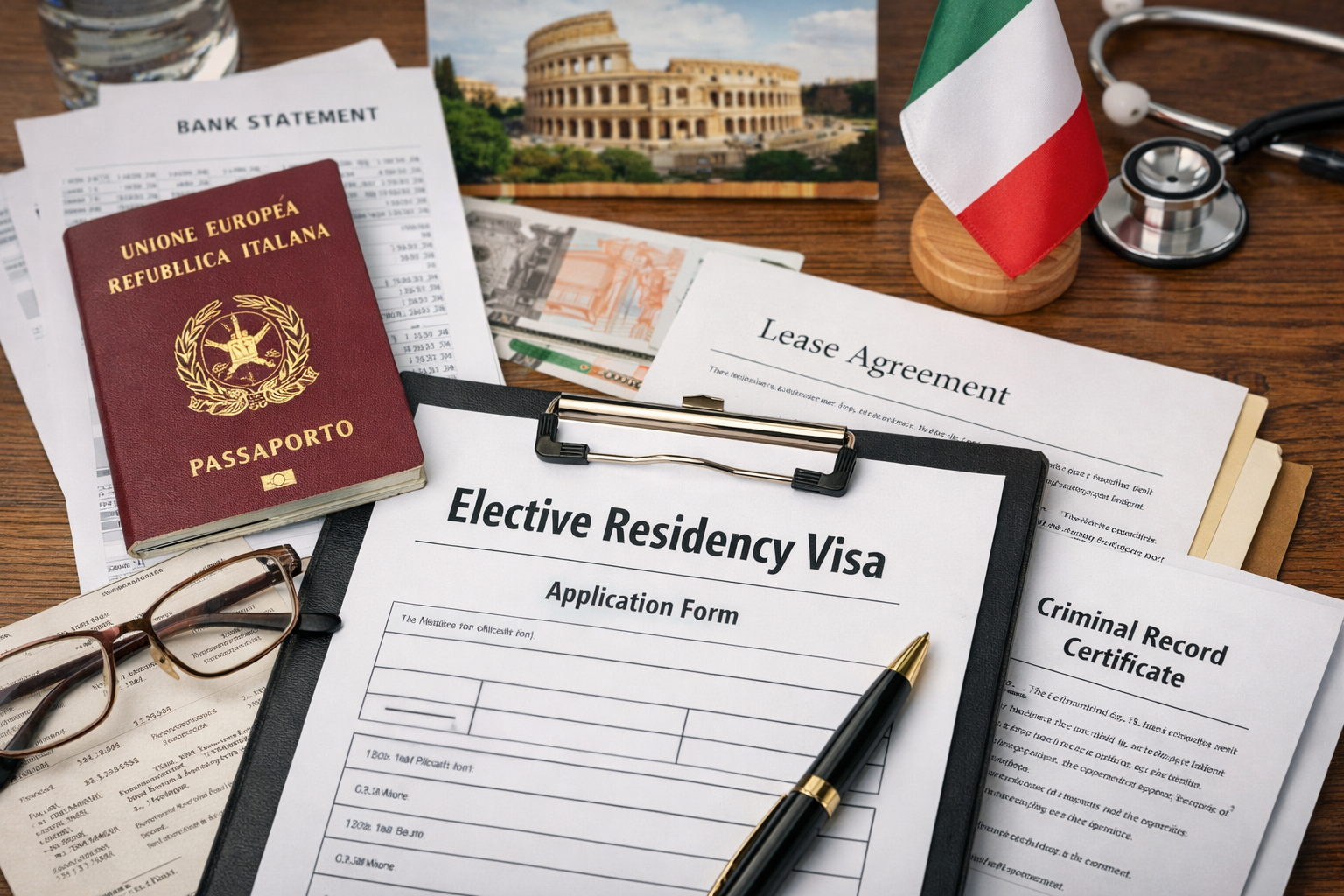
Introduction
Understanding the documents required for an elective residency visa in Italy is a crucial step for non-EU citizens planning to relocate. Many applicants underestimate this phase, assuming that collecting documents is a simple administrative task. In reality, consulates carefully evaluate not only the presence of documents, but also their consistency and legal validity.
For this reason, preparing documentation correctly from the beginning can significantly reduce delays and improve the chances of approval. Moreover, a structured approach helps avoid common mistakes that may lead to additional requests or even rejection.
Overview of Document Requirements
The elective residency visa requires applicants to submit a comprehensive set of documents demonstrating financial independence, accommodation in Italy, and overall eligibility.
In general, consulates expect documentation that proves:
- Identity and personal status
- Financial capacity and passive income
- Availability of suitable accommodation in Italy
- Health insurance coverage
- Absence of risk for public security
However, requirements may vary slightly depending on the consulate. Therefore, each application should be prepared taking into account the specific practices of the relevant authority.
For a complete overview of the application process, including legal requirements and practical steps, read our full guide on the elective residency visa Italy.
Personal Documents
The first category includes personal identification documents. These are essential to establish the applicant’s identity and legal status.
Typically required documents include:
- Valid passport
- Passport-sized photographs
- Visa application form
- Civil status certificates (such as marriage or birth certificates, if applicable)
In addition, some consulates may require legalized or translated versions of these documents. Consequently, applicants should verify local requirements in advance.
Financial Documentation
Financial documentation represents one of the most critical aspects of the application. Consulates assess whether the applicant can support themselves without working in Italy.
Required documents usually include:
- Bank statements
- Proof of passive income
- Tax returns
- Investment portfolios or financial reports
It is important that all financial documents are consistent, traceable, and clearly demonstrate long-term stability.
To better understand how consulates evaluate income levels and minimum thresholds, you can read our detailed guide on elective residency visa Italy income requirements.
Proof of Accommodation in Italy
Applicants must demonstrate that they have a place to live in Italy. This requirement can be satisfied in different ways.
Commonly accepted documents include:
- Rental agreements
- Property ownership deeds
- Declarations of hospitality
However, accommodation must be suitable and verifiable. In some cases, consulates may request additional confirmation.
Practical Case
An applicant submitted a short-term rental contract without clear duration. As a result, the consulate requested further documentation.
After providing a long-term lease agreement, the application proceeded without issues. This example shows the importance of clear and stable housing arrangements.
Strategic Note
Before signing a rental agreement or purchasing a property in Italy, it is advisable to carefully evaluate the legal implications of the transaction.
Before renting or buying a property, consider contacting our legal team.
We provide legal assistance to ensure that such an important step is carried out safely and in full compliance with Italian regulations.
Health Insurance Requirements
Another essential element concerns health coverage. Applicants must demonstrate that they are covered for medical expenses in Italy.
Typically required:
- Private health insurance policy
- Coverage valid in Italy
- Minimum coverage aligned with consular expectations
Moreover, the policy must cover the entire duration of the initial stay.
Criminal Record Certificate
Many consulates require proof that the applicant does not pose a risk to public order.
This usually involves:
- Criminal record certificate from the country of residence
- Additional certificates from countries where the applicant has lived
These documents may need to be legalized and translated.
Document Formalities: Legalization and Translation
One of the most underestimated aspects concerns document formalities.
In many cases, documents must be:
- Translated into Italian
- Legalized or apostilled
- Formally certified
Moreover, it is important to highlight that poor translations or translations not carried out by qualified professionals may compromise the success of the application.
In practice, consulates expect accurate and legally reliable translations. Even minor inconsistencies or inaccuracies may lead to delays or requests for clarification.
For this reason, this phase should be considered a decisive step in the overall process.
Consistency and Coherence of Documentation
Consulates do not evaluate documents individually. Instead, they assess the overall coherence of the application.
For example:
- Financial documents must align with tax returns
- Accommodation must match declared residence plans
- Personal information must be consistent across all documents
As a result, even small inconsistencies may lead to additional scrutiny.
Practical Case
An applicant submitted financial statements that did not match declared income in tax returns. The consulate requested clarification, delaying the process.
After correcting the documentation, the application moved forward. This case highlights the importance of consistency across all documents.
Common Mistakes to Avoid
Several recurring mistakes can negatively impact the application process.
The most common include:
- Submitting incomplete documentation
- Providing inconsistent information
- Using documents that are not properly legalized
- Failing to demonstrate passive income clearly
Consequently, even well-prepared applicants may encounter issues if these aspects are overlooked.
Strategic Preparation Before Submission
Before submitting the application, it is advisable to review all documentation carefully.
In particular, applicants should verify:
- Completeness of the document set
- Consistency between documents
- Compliance with consular requirements
- Proper translation and legalization
Moreover, preparing documents in advance can significantly reduce processing time.
Final Considerations
The documents required for an elective residency visa in Italy go beyond a simple checklist. Instead, they represent a structured set of evidence supporting the applicant’s eligibility.
A well-prepared application combines accurate documentation, consistency, and strategic presentation. In many cases, the success of the application depends on how effectively these elements are managed.
Frequently Asked Questions
What documents are required for an elective residency visa in Italy?
Applicants must provide personal documents, financial evidence, proof of accommodation, health insurance, and criminal record certificates.
Do documents need to be translated?
Yes, in most cases documents must be translated into Italian and properly legalized.
Is financial documentation mandatory?
Yes, it is one of the most important parts of the application and must demonstrate passive income.
Can requirements vary by consulate?
Yes, each consulate may apply slightly different procedures and requirements.
Learn More
Looking for more detailed answers?
Explore our complete guide on the elective residency visa Italy to better understand requirements, procedures and legal aspects.
Get Professional Guidance
Before submitting your application, it is essential to ensure that your documentation is complete, consistent, and compliant with consular standards.
Contact our legal team to receive a tailored assessment. We can also assist you in evaluating alternative immigration options to Italy, including the Investor Visa and the Digital Nomad Visa, depending on your specific situation.
Written by Gabriele Vaccaro, Italian lawyer focused on international law and legal assistance for Italian residency visas.


